Every company needs someone to make decisions.
Because if all shareholders collectively started managing day-to-day operations, corporate meetings would quickly turn into reality shows with PowerPoint presentations and passive-aggressive voting.
This is why companies appoint directors — the individuals entrusted with managing the affairs of the company under the Companies Act, 2013. Directors are often described as the “brain” of the company because they control business decisions, policies, finances, expansion, and management. Which sounds powerful until something goes wrong and suddenly everyone says:
“Who approved this?”
And all eyes slowly turn toward the directors.
In simple words, directors are individuals elected or appointed to manage the company on behalf of shareholders. Since a company is an artificial legal person incapable of physically making decisions, it acts through human agents known as directors. After all, a company cannot personally attend meetings, sign documents, or panic during compliance deadlines. Humans do that part.
The Board of Directors collectively manages the company’s affairs. This group is responsible for major decisions involving:
- Business strategy
- Investments
- Borrowing
- Corporate governance
- Appointments
- Financial management
Essentially, directors are expected to ensure the company grows responsibly and legally. Unfortunately, history has repeatedly shown that some directors interpret “corporate leadership” as:
“Let us try extremely questionable financial decisions with confidence.”
Under Company Law, the first directors are usually named in the Articles of Association. Later, directors may be appointed by shareholders in general meetings. Public companies generally require at least three directors, private companies require two, and One Person Companies require one. Because apparently even the law recognizes that one human alone can indeed create an entire company powered by ambition, caffeine, and poor sleep schedules.
Every director must obtain a Director Identification Number (DIN), which acts like an official corporate identity number. This helps track directors and ensures people cannot casually disappear after destroying one company only to reappear in another city calling themselves “strategic consultants.”
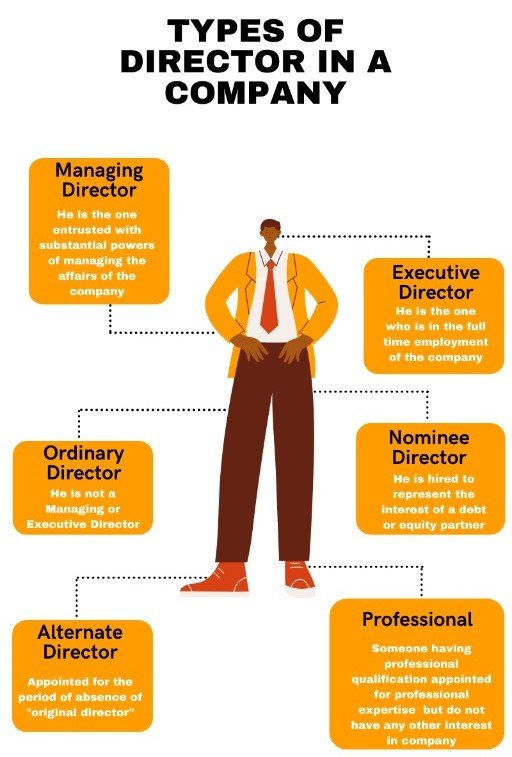
There are different types of directors under the Companies Act, and honestly, the categories sometimes sound like characters in a corporate cinematic universe.
First comes the executive director — actively involved in day-to-day management. These are the people constantly attending meetings, approving decisions, checking reports, and saying things like:
“Let’s circle back to this.”
Then comes the non-executive director, who participates in policy decisions but is not involved in daily operations. They are like experienced observers ensuring management does not accidentally drive the company into legal disaster.
Independent directors are particularly important in listed companies. These directors are expected to act impartially and protect corporate governance standards. They are called “independent” because they should not be excessively connected to company management. In theory, they act as objective watchdogs. In practice, they sometimes sit through meetings wondering:
“How did this situation become my problem?”
Another category is nominee directors, appointed by institutions such as banks or financial corporations to protect their interests. Because lenders enjoy monitoring exactly where their money is going instead of relying entirely on optimistic presentations beginning with:
“Trust us.”
One of the most important concepts relating to directors is fiduciary duty. Directors occupy a position of trust and must act honestly, carefully, and in the best interests of the company. They are expected to exercise:
- Good faith
- Due care
- Skill
- Independent judgment
This means directors cannot legally treat company funds like personal festival shopping budgets.
Section 166 of the Companies Act lays down directors’ duties very clearly. Directors must act in good faith to promote the objectives of the company for the benefit of:
- Shareholders
- Employees
- Community
- Environment
Yes, modern Company Law expects directors not only to generate profits but also to behave responsibly toward society. Corporate law evolved from:
“Make money”
to
“Please make money without destroying civilization.”
Directors must also avoid conflicts of interest. Suppose a director secretly awards massive company contracts to his own cousin’s suspiciously overpriced business. The law generally reacts very negatively to such creativity.
Another major duty is the duty of care and skill. Directors are expected to make informed decisions and exercise reasonable diligence. They cannot defend disastrous decisions by saying:
“I was simply vibing professionally.”
However, directors are not expected to guarantee business success. Companies can fail despite honest efforts because business involves risk. The law punishes negligence, fraud, dishonesty, and reckless conduct — not genuine commercial failure.
Now let us discuss directors’ powers, because with great power comes:
- Legal responsibility
- Compliance obligations
- Potential litigation
- And approximately seventeen board meetings per month
The Board of Directors exercises powers such as:
- Borrowing money
- Issuing shares
- Approving financial statements
- Appointing managerial personnel
- Entering contracts
- Expanding business operations
Certain powers, however, require shareholder approval because Company Law does not entirely trust directors with unlimited authority. Which is understandable considering corporate history contains enough scandals to fill streaming documentaries for decades.
Directors may also incur personal liability in certain situations involving:
- Fraud
- Misstatements in prospectus
- Breach of fiduciary duty
- Non-compliance
- Oppression and mismanagement
This becomes especially important because incorporation and separate legal personality usually protect members from personal liability. But when directors misuse their position, the law sometimes decides:
“Actually, this problem belongs to you personally.”
One cannot discuss directors without mentioning the famous corporate scandals that transformed governance standards globally. Cases involving fraud and financial manipulation taught lawmakers that unchecked corporate power can cause enormous harm. As a result, modern Company Law increasingly emphasizes:
- Transparency
- Accountability
- Corporate governance
- Independent oversight
Because apparently trusting executives blindly with billions of rupees occasionally leads to complications.
For CLAT PG aspirants, directors are among the most important topics in Company Law because they connect with:
- Corporate governance
- Company management
- Fiduciary obligations
- Corporate liability
- Shareholder protection
Questions frequently appear regarding:
- Appointment and removal of directors
- Duties under Section 166
- Independent directors
- Powers of the Board
- Fiduciary duties
- Directors’ liabilities
The topic becomes easier once students stop viewing directors as mysterious corporate figures and start understanding them as legally accountable decision-makers operating within a structured system.
At its core, Company Law treats directors as guardians of corporate responsibility. They manage companies not for personal gain but for the benefit of the company and its stakeholders. The law grants them significant powers because businesses need leadership and flexibility. But at the same time, it constantly reminds them:
“If you misuse those powers, there will be consequences.”
Which is honestly a reasonable rule for anyone managing other people’s money while wearing expensive suits and discussing “long-term strategic vision.”