If jurisprudence were a competition for “Most Likely to Give Law Students Existential Crisis,” Hans Kelsen would win comfortably. While other jurists debated morality, society, justice, and human behaviour, Kelsen entered the discussion and said, “What if we remove all emotions, politics, morality, sociology, and basically everything interesting from law?” Thus was born the Pure Theory of Law — a theory so academically pure that many students feel spiritually impure after trying to understand it at 3 AM before exams.
Hans Kelsen was a legal positivist who believed law should be studied scientifically and independently from morality, religion, politics, or social factors. According to him, jurisprudence had become messy because philosophers kept mixing law with ethics and emotions. Kelsen wanted to create a “pure” theory focusing only on legal norms. Imagine someone cleaning a room so aggressively that even the furniture disappears — that is essentially what Kelsen attempted with jurisprudence.
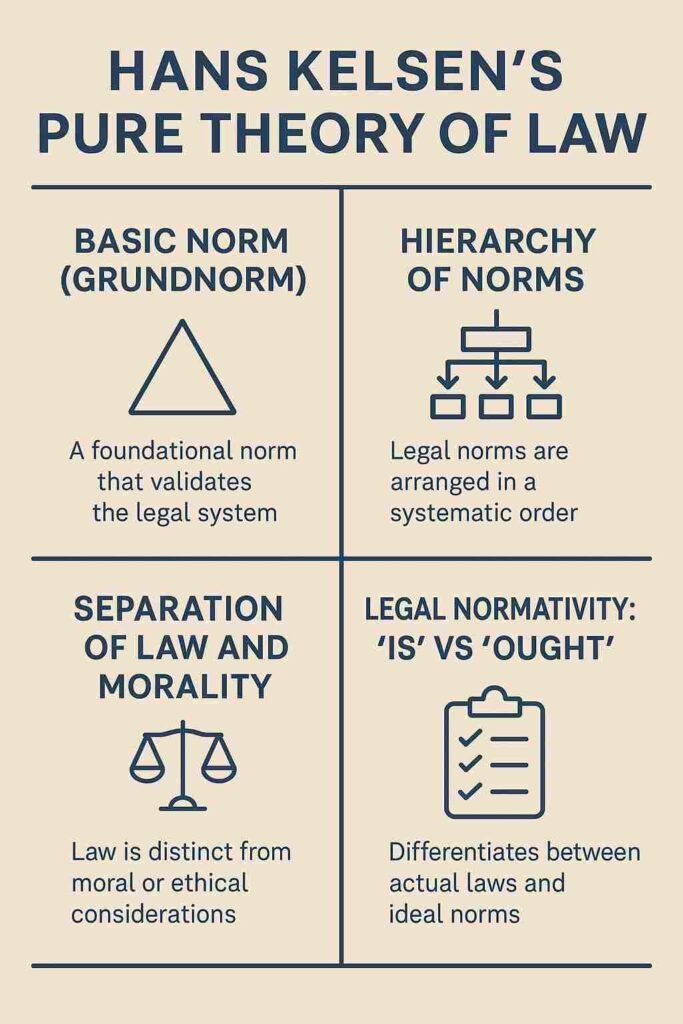
The central idea of Kelsen’s theory is that law is a hierarchy of norms, where each law derives its validity from a higher law above it. This hierarchy continues upward until we eventually reach the ultimate foundational norm called the Grundnorm or “Basic Norm.” The Grundnorm is the reason the entire legal system is considered valid. It is not written anywhere, nor enacted by any authority, but it is assumed to exist so the legal system can function logically. Yes, Kelsen basically built an entire legal theory around an invisible assumption and somehow made generations of law students accept it respectfully.
Kelsen explained legal systems like a pyramid. At the top lies the Grundnorm. Below it comes the Constitution, then statutes passed by the legislature, then delegated legislation, and finally individual acts and decisions. Every lower norm gets its validity from the higher norm above it. For example, a traffic rule is valid because it comes from legislation, legislation is valid because it follows the Constitution, and the Constitution is valid because society accepts the Grundnorm. If this sounds confusing, do not worry — many law students also stare at this theory the same way people stare at modern art in museums while pretending they understand it.
The Grundnorm itself is not a moral principle or divine command. Kelsen insisted it is merely a hypothetical assumption necessary for the legal system. In India, one could say the Grundnorm resembles the acceptance that “the Constitution ought to be obeyed.” Everything flows from that foundational acceptance. Kelsen did not care whether the Constitution was morally perfect; he only cared whether the legal system functioned logically and systematically. Natural law theorists probably fainted dramatically after hearing this.
One of the greatest strengths of Kelsen’s theory is its structured and scientific approach. It explains how legal systems maintain order and validity through hierarchical relationships. His theory also strongly influenced constitutional law and judicial review. Modern constitutional systems often resemble Kelsen’s pyramid structure, where all laws must conform to the Constitution. Whenever courts strike down unconstitutional laws, somewhere in the jurisprudential universe Kelsen probably whispers, “Exactly as planned.”
However, Kelsen’s theory has also faced criticism. Critics argue that law cannot be separated entirely from morality, politics, or society because legal systems operate within human communities, not inside philosophical laboratories. Others question the very idea of the Grundnorm. If the Grundnorm itself is hypothetical, where does its authority come from? At some point, Kelsen’s theory starts sounding like an infinite legal version of “because I said so.” Critics also argue that revolutions and constitutional changes create difficulties for his theory. If a new constitution replaces the old one after a revolution, does the Grundnorm also magically change overnight? Kelsen’s answer was essentially yes — which is intellectually fascinating and slightly terrifying.
Another criticism is that Kelsen ignored the human side of law. Sociological jurists believed law cannot survive in isolation from society, while realists argued judges and politics influence law far more than abstract hierarchies of norms. Kelsen, meanwhile, remained committed to keeping law “pure” from outside influences, like a legal monk meditating peacefully while the rest of jurisprudence argued loudly around him.
For CLAT PG aspirants, Kelsen is extremely important because questions frequently appear on the Pure Theory of Law, hierarchy of norms, Grundnorm, and criticism of his theory. But beyond exams, Kelsen’s work teaches an important lesson about legal systems: laws do not exist randomly; they operate within structured frameworks of authority and validity. His theory may appear abstract, but it profoundly shaped modern constitutional thinking across the world.
At the end of the day, Hans Kelsen gave jurisprudence one of its most intellectually rigorous theories. He transformed law into a carefully organized system of norms and validity. He also unintentionally ensured that thousands of law students would forever use the word “Grundnorm” in exams while secretly praying nobody asks them to explain it in simple language.