At some point in jurisprudence, certain legal thinkers looked at thick law books, complicated theories, and endless philosophical debates and collectively decided, “What if we stop pretending law is perfect?” Thus began the Realist movement — a school of jurisprudence that focused less on abstract legal theories and more on how law actually works in real life. Realists believed that law is not just what is written in statutes or textbooks; it is what judges, lawyers, police officers, and courts actually do in practice. In other words, realism brought jurisprudence crashing down from philosophical clouds directly into the chaos of real society, where cases depend not only on logic but also on human behaviour, social pressures, and occasionally whether someone had enough coffee before court.
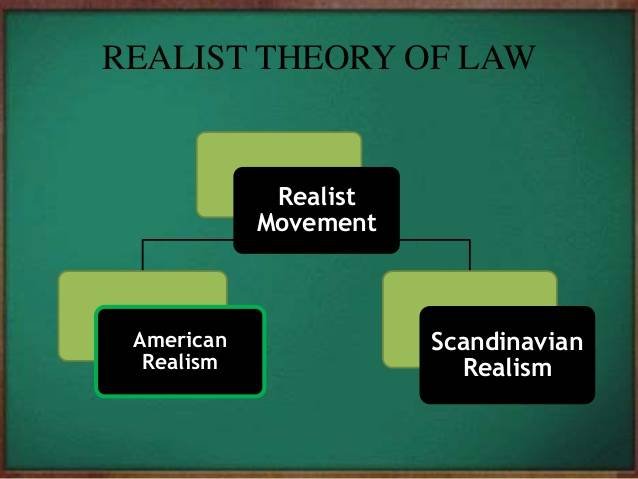
Realism mainly developed in two forms: American Realism and Scandinavian Realism. Both schools challenged traditional legal theories, but they approached realism differently. American Realists focused on judicial behaviour and practical outcomes, while Scandinavian Realists focused more on psychology, language, and how people perceive legal authority. Together, they ensured that law students everywhere would permanently lose confidence in the idea that legal systems are completely objective.
American Realism emerged in the early twentieth century, mainly in the United States. Thinkers like Oliver Wendell Holmes Jr., Jerome Frank, and Karl Llewellyn argued that judges do not mechanically apply legal rules like emotionless robots. Instead, judicial decisions are influenced by social conditions, personal experiences, political beliefs, and practical consequences. Holmes famously stated, “The life of the law has not been logic; it has been experience.” This single sentence shattered the dreams of anyone who believed legal reasoning works like solving mathematics.
American Realists believed predicting judicial behaviour is more important than memorizing abstract legal principles. According to Holmes, law is essentially a prediction of what courts will do. If courts consistently punish theft, then society treats anti-theft rules as law. This approach shifted focus from theoretical definitions toward practical judicial outcomes. Jerome Frank took realism even further by arguing that judges’ personalities, emotions, and subconscious biases influence decisions. Frank basically looked at the legal system and politely informed everyone that judges are humans, not vending machines where you insert facts and automatically receive justice.
Karl Llewellyn emphasized that legal rules are often flexible and open to interpretation. Two judges may interpret the same provision differently depending on circumstances. This idea terrified students who believed there was always one perfectly correct legal answer hidden somewhere inside textbooks waiting to be discovered magically before exams.
Meanwhile, Scandinavian Realism developed in countries like Sweden and Denmark through thinkers such as Alf Ross and Karl Olivecrona. Scandinavian Realists were less interested in judicial behaviour and more interested in understanding the psychological foundations of law. They rejected metaphysical ideas like “natural rights” or “absolute justice,” arguing that such concepts are too vague and emotional. According to them, law should be understood scientifically through observable social facts and psychological responses.
Alf Ross argued that people obey laws because they psychologically believe legal systems possess authority. Scandinavian Realists believed legal concepts work because society collectively accepts and internalizes them. They viewed law as a social and psychological phenomenon rather than a divine or moral system. Honestly, Scandinavian Realism sometimes feels like jurisprudence attended a psychology seminar and never fully recovered.
One of the greatest contributions of realism was exposing the gap between “law in books” and “law in action.” Traditional legal theories often assume laws operate perfectly according to written rules, but realists showed that practical implementation is much more complicated. Factors like judicial discretion, social inequality, economic conditions, public opinion, and politics all influence legal outcomes. Realists reminded the world that legal systems function within messy human societies, not inside perfectly controlled laboratory conditions.
Realism also significantly influenced modern legal education and judicial studies. Today, legal scholars frequently study how judges actually decide cases, how social conditions influence courts, and how laws impact ordinary people. Fields like critical legal studies, behavioural law, and empirical legal research owe much to realist thinking.
However, realism has faced criticism too. Critics argue that excessive focus on judicial discretion creates uncertainty and weakens faith in legal consistency. If law depends heavily on judges’ personalities and social conditions, then predictability becomes difficult. Some critics even accuse realists of making law appear unstable or subjective. After all, society becomes slightly nervous when legal systems start sounding like personality-driven improvisation.
Despite criticism, realism remains one of the most influential movements in modern jurisprudence because it forced legal thinkers to confront reality honestly. It challenged the illusion that legal systems operate mechanically and perfectly. Realists showed that law is deeply connected with human psychology, politics, and social conditions.
For CLAT PG aspirants, American and Scandinavian Realism are extremely important topics because questions frequently appear regarding Holmes, Jerome Frank, Alf Ross, judicial behaviour, and prediction theory. But beyond examinations, realism teaches a valuable lesson: law is not merely a collection of rules written on paper. It is a living process shaped by real people making decisions in an imperfect world. Also, it gently informs law students that memorizing bare acts alone will not magically explain why judges occasionally interpret the same law in completely opposite ways.